John Constable Biography
John Constable was one of the major European landscape artists of the XIX century, whose art was admired by Delacroix and Gericault and influenced the masters of Barbizon and even the Impressionists, although he did not achieved much fame during his lifetime in England, his own country. John Constable was born in East Bergholt, Suffolk, on 11 June 1776, the fourth child and second son of Ann and Golding Constable. His father was a prosperous local corn merchant who inherited his business from an uncle in 1764. Constable was educated at Dedham Grammar School, where he distinguished himself more by his draughtsmanship than his scholarship. In 1793 his father decided to train him as a miller and, consequently, Constable spent a year working on the family mill, which helped him to determine his course of life: he would be an artist.
In 1796-1798 he took lessons from John Thomas Smith and later from George Frost, who supported his love of landscape painting and encouraged him to study Gainsborough's works. In 1700 he entered the Royal Academy Schools. As a student he copied Old Master landscapes, especially those of Jacob van Ruisdael. Though deeply impressed by the work of Claude Lorrain and the watercolours of Thomas Girtin, Constable believed the actual study of nature was more important than any artistic model. He refused to "learn the truth second-hand". To a greater degree than any other artist before him, Constable based his paintings on precisely drawn sketches made directly from nature. His most notable picture of his early works are Dedham Vale (1802), 'A Church Porch' (The Church Porch, East Bergholt) (1809), Dedham Vale: Morning (1811), Landscape: Boys Fishing (1813), Boatbuilding (1814), Wivenhoe Park (1816), Weymouth Bay (1816). Flatford Mill (1817) was his last work of the period, created en plein-air.
He married Maria Bicknell in 1816 and they settled in London. After 1816 he changed the method of his work turning away from realistic agrarian landscapes such as Landscape: Ploughing Scene in Suffolk (A Summerland) (1814). Now he was working mostly in his studio in London and had to work out the image from his memory, starting each picture from a full-size sketch. The sketches enabled his memory to develop gradually until everything he could remember about the scene was satisfactorily suggested. At this point he would begin the finished painting. Each of his large canvass starting with The White Horse (1819) and continuing through Landscape: Noon (The Hay-Wain) (1821), The Lock (A Boat Passing a Lock) (1824), The Leaping Horse (1824-1825), The Cornfield (1826) was fulfilled in this way.
Although he never was popular in England, some of his works were exhibited in Paris and achieved instant fame. In 1829 he was finally elected a Royal Academician. His other important works of these period were Hampstead Heath (c.1820), Salisbury Cathedral, from the Bishop's Grounds (1823), A Mill at Gillingham in Dorset (Parham's Mill) (1826), Dedham Vale (1828), Hadleigh Castle (1829), Old Sarum (1829), Salisbury Cathedral, from the Meadows (1831). He died on 31st of March, 1837 working on his last picture Arundel Mill and Castle (1837).
Bibliography
John Constable. The Man and His Work. by C. Peacock. London. 1965.
John Constable. by A. Tchegodayev. Moscow. 1968.
John Constable’s Correspondence. by R. B. Beckett. London. 1968.
Painting of Europe. XIII-XX centuries. Encyclopedic Dictionary. Moscow. Iskusstvo. 1999.
Constable (World of Art) by Michael Rosenthal. Thames & Hudson, 1987.
Memoirs of the Life of John Constable (Arts & Letters) by Charles Robert Leslie, Jonathan Mayne (Editor). Phaidon Press Inc., 1995.
The Early Paintings and Drawings of John Constable: Text and Plates by Graham Reynolds. Paul Mellon Center, 1996.
Constable: The Life and Masterworks by Barry Venning. Parkstone Press, 2005.
John Constable: The Man and His Art by Ronald Parkinson. Victoria & Albert Museum, 1998.
Constable and His Drawings by Ian Flemming-Williams. Philip Wilson Publishers, 1990.
- Dedham Vale.
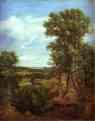
1802. Oil on canvas. Victoria and Albert Museum, London, UK.
- 'A Church Porch' (The Church Porch, East Bergholt).
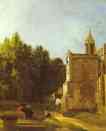
1809. Oil on canvas. Tate Gallery, London, UK.
- Dedham Vale: Morning.
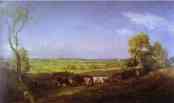
1811. Oil on canvas. Private collection.
- Landscape: Boys Fishing.
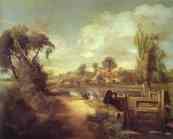
1813. Oil on canvas. National Trust, Fairhaven Collection, Anglesea Abbey, UK.

