Paul Cézanne Biography
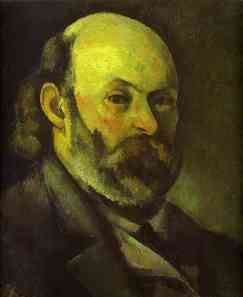
Paul Cézanne was born into a family of Italian origin in Cesana Forinese. His father had established a felt hat business in Aix-en-Provence and later became a banker. In 1859 he bought a country house on the outskirts of Aix, the Jas de Bouffan, which was to be frequently represented in Cézanne’s paintings.
Between 1852 and 1859 Paul Cézanne studied at the Collège Bourbon and it was there that he formed a friendship with Emile Zola, with whom he shared an interest in literature. In 1856 Cézanne began to attend the evening drawing courses of Joseph-Marc Gibert at the Aix Museum. From 1859 to 1861 he studied law at Aix, entered his father’s bank. By April 1861 his father had finally yielded to Cézanne’s desire to make a career in art and allowed him to go to Paris to study at the Académie Suisse. In Paris Cézanne frequented the Louvre, met Pissarro and Guillaumin and, later on, Monet, Sisley, Bazille and Renoir. In September of the same year he was refused admission to the Ecole des Beaux-Arts and went back to Aix, to the great relief of his father, who offered him a position in his bank. But in November 1862 Paul Cézanne went back to Paris and took up painting again.
During his so called “dark” or “romantic” period (1862-70) Paul Cézanne often visited Paris; he met with Edouard Manet and the future Impressionists, and tried to be accepted at the Salon. The Franco-Prussian War drove him to L’Estaque near Marseilles. Paul Cézanne’s “Impressionist” period (1873-79) is connected with his staying at Pontoise and Auvers-sur-Oise in 1872, 1873, 1874, 1877 and 1881; he worked with Pissarro and exhibited with the Impressionists in 1874 and in 1877. The canvases produced at L’Estaque (1880-83) and at Gardanne (1885-88) are usually referred to Paul Cézanne’s “constructive” period. In 1886 after his father’s death, Cézanne married Hortense Fiquet, with whom he had a secret liaison since 1870. She is said to look after the finished canvases, which Cézanne never took care to keep and abandoned as soon as he completed the painting. The same year Cézanne quarelled with Zola over the novel “L’Oeuvre”, in which the central figure, an unsuccessful and unbalanced painter, was identified with Cézanne.
In 1887, after a long break, Cézanne participated in the exhibition of Les XX at Brussels. Towards the beginning of Paul Cézanne’s “synthetic” period (1890-1906) the younger generations of artists started to take an interest in him. His first one-man show was held in the Vollard Gallery in 1895. During these years the artist seldom visited Paris – his longest stays there took place in 1895, 1899 and 1904 – and produced many versions of canvases depicting Mount Sainte-Victoire, smokers, card-players and bathers, and painted still lifes and portraits. By 1901 Cézanne had become recognized. He often met with young artists who admired his work – Denis, Bonnard and Vuillard. In 1901 Denis painted Hommage à Cézanne. The future Fauvist Charles Camoin sought his advice, and in 1904 he was visited by Emile Bernard, an artist of the Pont-Aven school, with whom Cézanne corresponded extensively, expounding his views on art.
In 1904 his paintings were shown for the first time at the Autumn Salon in Paris; and a year after his death, in 1907, a retrospective exhibition of his works was held there.
Bibliography
Paul Cézanne. Aurora Art Publishers. Leningrad. 1975.
Cézanne. by Mircea Toca. Editions Meridiane. Bucharest. 1984.
Painting of Europe. XIII-XX centuries. Encyclopedic Dictionary. Moscow. Iskusstvo. 1999.
Paul Cezanne (Masters of Art Series) by Meyer Schapiro, Mike Cezanne (Photographer). Harry N Abrams, 1988.
Cezanne (Art & Ideas) by Mary Tompkins Lewis. Phaidon Press Inc., 2000.
Cezanne and Provence: The Painter in His Culture by Nina Maria Athanassoglou-Kallmyer. University of Chicago Press, 2003.
Cezanne in the Studio: Still Life in Watercolors by Carol Armstrong, Deborah Gribbon. J. Paul Getty Trust Publications, 2004.
Cezanne's Garden by Derek Fell. Simon & Schuster, 2004.
Paul Cezanne, Letters by Paul Cezanne, John Rewald Da Capo Press, 1995.
Cezanne: Landscape into Art by Pavel Machotka. Yale University Press, 1996.
Van Gogh and Friends Art Game: With Cezanne, Gauguin, Seurat, Rousseau and Toulouse-Lautrec by Wenda Brewster O'Reilly. Birdcage Books, 2002.
- The Bathers.
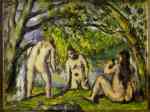
Oil on canvas. Barnes Foundation, Lincoln University, Philadelphia, PA, USA.
- Bread And Eggs.
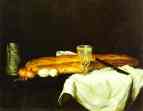
1865. Oil on canvas. Cincinnati Art Museum, Cincinnati, USA.
- Uncle Dominique.
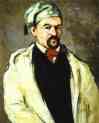
c.1866. Oil on canvas. The Metropolitan Museum of Art, New York, USA.

