Mary Cassatt Biography
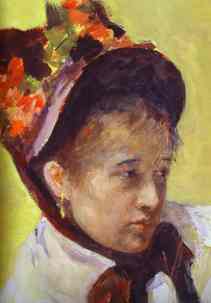
Mary Stevenson Cassatt was born on May 22, 1844 in Allegheny City, Pennsylvania, US, into a well-to-do family. Her father, Robert Cassatt, was a successful stockbroker and financier. Her mother, Katherine Kelso Johnston, came from a banking family, which had provided her with a good education. The Cassatt family was of French Huguenot origin; they escaped persecutions and came to New York in 1662.
During the childhood of the future artist, the family traveled in Europe, lived in France and Germany (1851-1855). During her 4-year stay in Europe Mary became fluent in French and German. Returning to Pennsylvania in 1855, the Cassatt family settled in Philadelphia. At the age of 15 Mary decided to become an artist and enrolled in 1861 at the Pennsylvania Academy of the Fine Arts in Philadelphia. She took art classes for 4 years (1861-65) and continued to pursue studies on her own. Soon she got frustrated with the education in the US. She felt she needed to study in Europe, her choice was Paris. Her mother supported her daughter’s desire. Since the Ecole des Beaux-Arts did not admit women, she (in 1866) studied for a short period in the studio of Charles Chaplin, then took private lessons from Jean-Léon Gérôme. In addition, Cassatt registered among the copyists at the Louvre. In 1868 her painting was exhibited for the 1st time in the Salon. The most important influence on Cassatt in the years before 1875 was exercised by Edouard Manet, although he did not accept students, she saw his works and they were much discussed both by painters and art critics.
The Franco-Prussian war (1870) made Cassatt return to the US for the next year and a half. The US atmosphere was so discouraging that she almost gave up painting. Late in 1871 she was on her way back to Europe, setting in Parma, where she copied works by Correggio for the archbishop of Pittsburgh. In Parma she spent 8 happy months.
In late September of 1872 she went to Spain studying first the paintings of Velázquez, Murillo, Titian, and Rubens at the Prado, then continuing on to Seville, where she began to paint her first major body of works based on Spanish subjects: Spanish Dancer Wearing a Lace Mantilla, Toreador and others.
After a brief return to Paris in April of 1873, she visited Holland and Belgium, and then traveled back south to Rome. In 1874 Cassatt finally decided to settle in Paris. Aided by her elder sister, Lydia, who joined Mary in Europe, she took an apartment and studio.
Lydia was not only the elder sister, but also the closest friend and model of Mary. There are eleven known works with Lydia, among them are The Cup of Tea, Lydia Working at a Tapestry Loom, Lydia Crocheting in the Garden at Marly, Woman and Child Driving. Lydia died at the end of 1882 of Bright’s disease, and it was a severe blow to Mary.
Cassatt became known as a portrait painter and was sought after by American visitors to France: Portrait of an Elderly Lady. As the sitters are often known, many of Cassatt’s works can be considered portraits: Mary Ellison Embroidering, Reading Le Figaro.. Her work differed from the stiff academic tradition of portrait painting as a mere likeness insofar as most of her subjects were either engaged in some kind of activity or caught in a casual pose.
In 1877 Cassatt met Degas, who advised her to join the Impressionists. “I accepted with joy. Now I could work with absolute independence without considering the opinion of a jury. I had already recognized who were my true masters. I admired Manet, Courbet, and Degas. I took leave of conventional art. I began to live.” A close friendship with Degas began, which lasted until Degas’ death in 1917. Degas and Renoir greatly influenced her style of painting. For a long time Cassatt was even thought of as a pupil of Degas. Though their relations were those of two friends, and the influence was mutual. Once, on seeing some of Mary’s work, Degas said that he would not have admitted that a woman could draw so well.
In 1877 her parents came to Paris to live with her permanently. Success of the IV Impressionist Exhibition, and Cassatt’s in particular, made her father believe at last that the daughter had chosen the right way in life. Between 1879 and 1882 The Independents, as the Impressionists used to call themselves, held their group exhibitions annually, thus providing Cassatt with the opportunity to show her work. In the US she was exhibiting regularly with the Society of American Artists in New York.
The two decades around the turn of the century proved to be a highly successful and productive period for Cassatt. She focused almost exclusively on the depiction of mothers and children, these works today are her best-known and most popular, e.g. The Child's Caress., The Bath. Almost all of Cassatt’s mother and child scenes do not depict actual mothers with their own children, since the artist preferred to select his models and match the appropriate physical types in order to achieve the desired results. From 1890 she also produced prints, e.g. The Letter, In the Omnibus, etc. Cassatt’s father died in 1891, and the mother in 1895.
In 1898 Mary returned to the US for the 1st time in over 25 years, visiting relatives, friends and collectors. In 1901 she visited Italy and Spain, in 1908 made the last trip to the USA. In 1910-12 she traveled extensively in Europe and in the Middle East. In 1904 she was accepted into the Legion of Honour and in 1910 became a member of the National Academy of Design in New York.
Cassatt’s last years were overshadowed with the loss of close people, relatives and friends. She suffered from many diseases, like diabetes and had cataracts on both eyes, which eventually reduced her to near blindness. She lived in solitude at the Château de Beaufresne, accompanied only by her longtime housekeeper, Mathilde Valet, or in the south of France. At the outbreak of WWI Cassatt had to give up painting entirely.
Mary Cassatt died at the Château de Beaufresne on June 14, 1926, and was buried in the family vault at nearby Mesnil-Théribus.
The majority of Cassatt’s works today are in American collections, while just a small number of paintings remain in France, where she worked. Her name is less familiar than those of her fellow Impressionist painters Degas, Monet or Renoir. However, Mary Cassatt is highly original and interesting painter and her talent does not yield to those with well-known names.
Bibliography
Art of the United States of America. 1675-1975. by A. Chegodayev. Moscow. Iskusstvo. 1976.
Cassatt and Her Circle: Selected Letters. by Nancy M. Matthews. Abbeville Press, Inc. 1984
Mary Cassatt: Reflections of Women's Lives by Debra N. Mancoff, Mary Cassatt. Stewart Tabori & Chang, 1998.
Mary Cassatt: A Life by Nancy Mowll Mathews. Yale Univ Pr, 1998.
Art In A Mirror: The Counterproofs Of Mary Cassatt by Warren Adelson (Foreword), Jay E. Cantor, Pamela A. Ivinski, Mary Cassatt, Marc Rosen, Susan Pinsky. Adelson Galleries, 2004.
Mary Cassatt: Painter of Modern Women (World of Art) by Griselda Pollock, Mary Cassatt. Thames & Hudson, 1998.
Mary Cassatt by Judith Barter. Harry N Abrams, 1998.
- Spanish Dancer Wearing A Lace Mantilla.
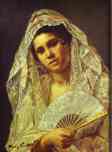
1873. Oil on canvas. The Smithsonian Institution, National Museum of American Art, Washington, D.C., USA.
- Young Woman Reading.
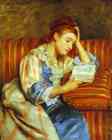
1876. Oil on canvas. The Museum of Fine Arts, Boston, MA, USA.
- The Cup Of Tea. (Portrait Of Lydia).
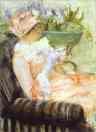
1879. Oil on canvas. The Metropolitan Museum of Art, New York, USA.
- Lydia At A Tapestry Loom.
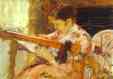
c.1881. Oil on canvas. Flint Institute of Arts, Flint, Michigan, USA.
- Lydia Crocheting In The Garden At Marly.
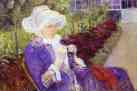
1880. Oil on canvas. The Metropolitan Museum of Art, New York, USA.
- Woman And Child Driving.
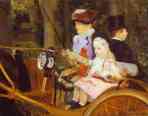
1881. Oil on canvas. Philadelphia Museum of Art, Philadelphia, PA, USA.
- Portrait Of An Elderly Lady.
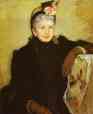
c.1887. Oil on canvas. The National Gallery of Art, Washington, DC, USA.

