Giovanni Antonio Canale, called Canaletto Biography
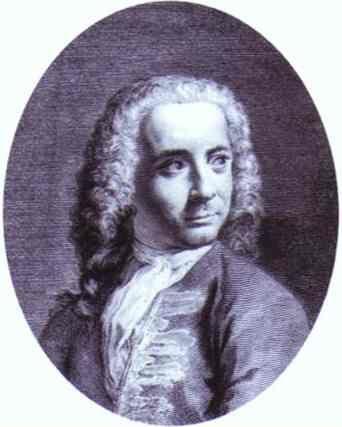
Giovanni Antonio Canale was born in October 1697 and baptized in the church of San Lio. He later became known as Canaletto, probably to distinguish him from his father Bernardo Canale, who was also an artist. The professional training Canaletto received from his father, who worked as a designer and scene painter for the theater, and had some success. Canaletto, together with his brother Christoforo, initially followed Bernardo, and was himself employed as a theatrical painter.
In 1719, he traveled with his father to Rome where he helped with the preparations for two operas by Scarlatti, performed during the carnival in 1720. This trip seems to have marked a turning point for the young artist. In Rome he could have come into contact with artists such as Gian Paolo Pannini (1691/2-1765), who produced vedute (view paintings), which Canaletto would later specialize in. In Rome, he also made a number of drawn studies of ancient sites, which were used as the basis for later works.
Within the Italian tradition of vedute (view painting) Canaletto explored different forms. He created vedute esatte (precise views), and also vedute ideale (imaginary or fantastic views), which are known as capricci, in these works Canaletto drew together architectural subjects from different sources and arranged them in an imaginative form to create a very consciously fictional and poetic image. Pictures of this type assume knowledge of their subjects on the part of the viewer, and were designed to appeal to the contemporary taste for ruins and the nostalgia they evoked.
In 1720, the artist’s name is first recorded in the register of the Venetian painters’ guild. Venice had a tradition of public exhibitions, at which painters, especially beginners, could promote their work. Canaletto is recorded as having hung a view of the church of Santi Giovanni e Paolo (probably Santi Giovanni e Paolo and the Scuola di San Marco) at the annual display of paintings organized outside the Scuola di San Rocco. His work was said to have ‘made everyone marvel’, and it was purchased by the Imperial Ambassador to Venice. The exhibition itself was later depicted by the artist in the background of his portrayal of the Doge procession The Doge Visiting the Church and Scuola di San Rocco.
After his success at the public exhibition, Canaletto was commissioned to paint four works for the merchant Stefano Conti (1725). Patrons such as Conti were important to Canaletto at the outset of his career, but it was English collectors who came to dominate the market for his view paintings. According to the fashion of the time it was considered that an essential part of good education and cultivation for the young English gentleman was to travel to Italy and visit the famous places of Rome, Florence and Venice. Of course, such travel also involved bringing home some refined souvenirs, and Canaletto tried to meet this demand.
Canaletto’s earliest work for the ‘English market’ came to him as a result of his contact with an Irishman called Owen McSwiney (c.1684-1754). Their acquaintance took place in 1720s, at least the first documentary mention of paintings, commissioned by Owen McSwiney, referred to 1826. McSwiney not only introduced Canaletto to English customers, but seems also to have encouraged the painter to create works which might particularly appeal to them.
The most important person in Canaletto’s career and his patron was Joseph Smith (c.1674-1770), an Englishman, who lived in Venice, and worked as an agent on behalf of British collectors of manuscripts, books and works of art; he also served as British Consul to the Venice Republic (1744-1760; 1766). He had a notable collection of his own. This collection in 1762-3 was sold to King George III, by that time it included the largest single group of works by Canaletto ever assembled.
In the 1730s, the demand for Canaletto’s work was so large that Canaletto employed studio assistants. Canaletto’s father probably helped him, and certainly Canaletto’s nephew Bernardo Bellotto (1720-80), who at the time was trained in his studio. In 1735, a set of engravings was published by Antonio Visentini after Canaletto’s paintings in Smith’s collection, called the Prospectus Magni Canalis Venetiarum, which also included the portrait of the artist, now considered the only reliable one.
In 1741, the War of the Austrian Succession broke out, which consequently undermined the tourist business; this meant that the artist’s was loosing his principal source of patronage. In addition, perhaps for the first time, Canaletto experienced some serious competition. Canaletto tried to expand the variety of his subjects. In 1740-41, he traveled along the Brenta Canal towards Padua, and made a number of drawings, which were to form the basis of etching and paintings. In 1742 Canalletto painted a series of five large paintings for Smith of ancient Roman ruins: Rome: the Arch of Constantine. Rome: Ruins of the Forum, looking towards the Capitol. Rome: The Arch of Septimius Severus. Rome: The Arch of Titus.
In 1746 Canaletto arrived in London; he worked in England intermittently until 1755. His first works in England were the views of the Thames and the recently completed Westminster Bridge: London: Westminster Bridge from the North on Lord Mayor's Day. London: Seen through an Arch of Westminster Bridge. Canaletto’s loyal agents Smith and McSwiney provided the artist with introduction to important patrons in London. Thus, through Smith’s assistance Canaletto was introduced to the Duke of Richmond, and some of the works Canaletto later painted for this patron: London: Whitehall and the Privy Garden from Richmond House. London: the Thames and the City of London from Richmond House. are widely considered his greatest achievements while in England. Later Canaletto painted subjects outside London – for example, the country homes of the Duke of Beaufort, the Earl of Warwick and the Duke of Northumberland: Warwick Castle: the East Front. London: Northumberland House.
Canaletto returned briefly to Venice in 1751 (and may also have traveled home again in 1753), but then remained in England up until 1755. Among the important works from this period are a series of capricci for the Lovelace family: Capriccio: River Landscape with a Column, a Ruined Roman Arch, and Reminiscences of England and a group of 6 pictures, which were painted for Thomas Hollis.
In 1755 the artist returned to Venice permanently. His last years in Venice from 1756 onwards were not as artistically noteworthy. Many of his later pictures were based on compositional and technical formulae worked out some years before. However, there are a few exceptions deserving attention: The Grand Canal Looking Down to the Rialto Bridge, The Campo di Rialto, The Vigilia di S. Pietro and The Vigilia di S. Marta, all four works were painted for the German patron Sigmund Streit; and the pair of views of the Piazza San Marco in the National Gallery, London: Piazza San Marco: Looking East from the North-West Corner; Piazza San Marco: Looking East from the South-West Corner.
In 1763 Canaletto was finally elected to the Venetian Academy of Fine Arts. His admission had been rejected previously, probably because view painting was not highly regarded by academicians. The artist’s reception piece Capriccio: Capriccio of Colonade and the Courtyard of a Palace was completed almost two years later. The very last of Canaletto’s dated works is the drawing San Marco: the Crossing and North Transept, with Musicians Singing. Canaletto died of a fever aged 71, on April 10, 1768. He was buried in the church of San Lio, where he had been baptized.
Bibliography
Painting of Venice. by Klára Garas. Corvina. Budapest. 1968.
Painting of Europe. XIII-XX centuries. Encyclopedic Dictionary. Moscow. Iskusstvo. 1999.
Canaletto by Terisio, Pignatti. Barrons Educational Series. 1980.
Canaletto by J. G. Links, Canaletto. Phaidon Press Inc., 1999.
Views of Venice by Canaletto by Antonio Visentini, Antonio Canaletto. Dover Pubns, 1971.
Venice through Canaletto's Eyes by David Bomford, Gabriele Finaldi. National Gallery London, 1998.
Canaletto's Sketchbook by Giovanna Nepi Scire. Canal and Stamperia Editorial, 1997.
- Santi Giovanni E Paolo And The Scuola Di San Marco.
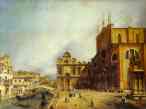
c.1725. Oil on canvas. Gemäldegalerie Alte Meister, Dresden, Germany. Read Note.
- The Doge Visiting The Church And Scuola Di San Rocco.
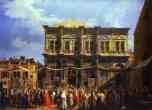
c.1735. Oil on canvas. National Gallery, London, UK. Read Note.
- Rome: The Arch Of Constantine.
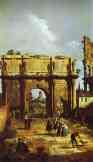
1742. Oil on canvas. Royal Collection, UK. Read Note.
- Rome: Ruins Of The Forum, Looking Towards The Capitol.
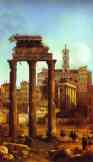
1742. Oil on canvas. Royal Collection, UK.
- Rome: The Arch Of Septimius Severus.
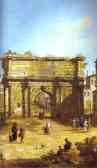
1742. Oil on canvas. Royal Collection, UK.
- Rome: The Arch Of Titus.
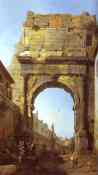
1742. Oil on canvas. Royal Collection, UK.
- London: Westminster Bridge From The North On Lord Mayor's Day.
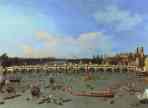
1746. Oil on canvas. Yale Center for British Art, New Haven, CT, USA. Read Note.
- London: Seen Through An Arch Of Westminster Bridge.
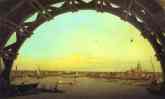
1746-7. Oil on canvas. Duke of Northumberland, UK.
- London: Whitehall And The Privy Garden From Richmond House.
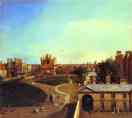
1747. Oil on canvas. Trustees of Goodwood House, West Sussex, UK.

