Robert Campin (Master of Flemalle) Biography
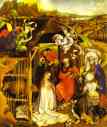
Campin was born around 1380 in Tournai, where he qualified as a master in 1406/07. Together with the Van Eyck brothers, he may be considered the founder of the Netherlandish painting of the Early Renaissance. While the influence of the Limburg brothers and Burgundian court art can still be felt in his early work (Betrothal of the Virgin and Annunciation), he soon turned to three-dimensional figure representation and the exploration of depth: Nativity. (c. 1425-1430). These reach a climax in Campin’s late works, in which the painter becomes almost obsessed with perspective (The Mérode Altar, so called after its original location, now in Metropolitan Museum). He was probably the teacher of Rogier van der Weyden from 1427 to 1432.
Not all art historians agree that Campin and Master of Flémalle, the name given to the unknown author of the altarpiece from Flémalle monastery, is the same person.
Bibliography
Painting of Europe. XIII-XX centuries. Encyclopedic Dictionary. Moscow. Iskusstvo. 1999.
Robert Campin: A Monographic Study With Critical Catalogue by Felix Thuerlemann. Prestel Publishing, 2002.
Robert Campin: New Directions in Scholarship by S. Foister, S. Nash. Brepols Publishers, 1996.