Jan Brueghel the Elder Biography
Because of his fondness of certain subjects and glowing enamel paint, Jan, the second son of Pieter Bruegel the Elder, was given the nickname “Velvet” or “Flower” Brueghel.
The first lessons he received from his grandmother, painter-miniaturist Mayken Verhulst Bessemers, who gave direction to his interests and technique, further developed by his teachers, including Pieter Goetkint and Gillis van Coninxloo (1544-1607). About seven years, 1589-1596, Brueghel spent in Italy: He worked in Naples (1590), Rome (1592-94), and then in Milan (1596) for Cardinal Federigo Borromeo, who became his patron.
In 1597 he returned to Amsterdam, where he became a member of the Lucas Guild in 1601. It is known that in 1604 he traveled to Prague. In 1610 the Archduke Albrecht of Austria, Spanish Governor of the Netherlands, appointed him a court painter. He was a friend of Rubens with whom he collaborated, including the magnificent flower garland in Rubens’ Madonna in the Flower Wreath while Rubens painted figures for many of his works, e.g. Adam and Eve in Paradise, Allegory of Sight et.al. Around 1613 Brueghel and Rubens together with Hendrick van Balen traveled to Holland.
Brueghel was well-to-do and respected, owning several houses in Antwerp as well as a considerable art collection.
Besides historical scenes, paradisiacal images of animals, and genre scenes, he was above all a painter of landscape and of flower pieces. As a specialist of “accessories” he collaborated with Frans Francken, Hans Rottenhammer and Joos de Momper, van Balen, F. Francken II et al.
His sons Jan Brueghel II (1601-78) and Ambrosius Brueghel (1617-75) copied his style and continued his work; their sons in their turn, carried on the tradition into the 18th century.
Bibliography
Dutch Genre Painting. XVII century. by E. Fehner. Moscow. Izobrazitelnoe Iskusstvo. 1979.
Painting of Europe. XIII-XX centuries. Encyclopedic Dictionary. Moscow. Iskusstvo. 1999
Jan Brueghel The Elder: The Entry Of The Animals Into Noah's Ark by Arianne Faber Kolb. J. Paul Getty Museum, 2005.
- Madonna In Floral Wreath.
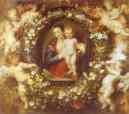
c.1620. Oil on oakwood. Alte Pinakothek, Munich, Germany.
- Adam And Eve In The Garden Of Eden.
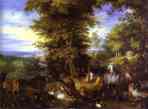
1615. Oil on copper. Royal Collection, UK. Read Note.

