Pieter Bruegel the Elder Biography
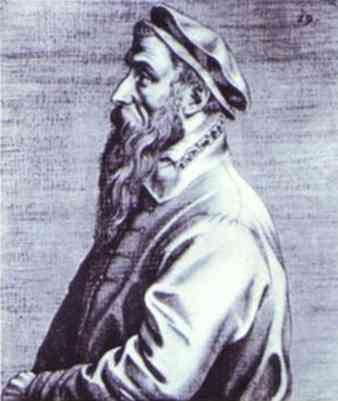
Pieter Bruegel the Elder, nicknamed ‘Peasant Bruegel’ was probably the most significant and exciting painter in the Northern Europe during the middle part of the sixteenth century. His nickname “Peasant Bruegel” indicates to his subjects: peasant life, proverbs and genre scenes, the New Testament topics set among common folks of contemporary Flanders.
The date and place of Bruegel’s birth are uncertain, most of the scholars consider he was born near Breda in the period between 1525- 1530. Until 1559 he spelt his name ‘Brueghel’, then as ‘Bruegel’, the reason for this change is unknown and his sons retained ‘h’ in their names.
Very probably the young Bruegel was apprenticed to Pieter Coeck van Aelst (1502–1550), a leading Antwerp artist, sculptor, architect, and designer of tapestry and stained glass, whose daughter Bruegel would later marry. In 1551 Bruegel became a Master of the Antwerp Guild. In 1552, 1553 and possibly for part of 1554 he traveled abroad. In 1552 he was in the south of Italy, visiting Reggio Calabria, Messina, Palermo and Naples, and in the following year he was in Rome, where he came into contact with a well-known painter and miniaturist of the time, Giulio Clovio, who created a small-scale picture of the Tower of Babel on ivory, and a View of Lyons (France). Both works are now lost. On his return journey to the Netherlands, Bruegel evidently spent some time in Switzerland, where he made many drawings of the Alps.
Back in Antwerp (late 1554-1555) Pieter Bruegel started working for Hieronymus Cock (1510-1570), the Antwerp engraver and publisher of prints. His Alpine sketches formed the basis of a number of elaborate landscape designs (dated from 1555 onwards), which were actually engraved by other artists. Cock was apparently pleased with Bruegel’s work for he was soon employing him on figure compositions as well. Of these, the serious of The Seven Deadly Sins (1556-7) and the famous Big Fish Eat Little Fish (engraved by Van der Heyden in 1557) are typical early examples. For the rest of his life Bruegel was active as both a painter and designer of prints, and the two activities were closely linked.
In 1563 Bruegel married Mayken, the daughter of Pieter Coeck and Mayken Verhulst Bessemers. His mother-in-law was also a painter, engaged in miniatures. Later, after the death of her son-in-law, she would give the first lessons in painting to his sons, Pieter and Jan. The couple settled in Brussels. In 1564 their first son, future painter Pieter Bruegel the Younger (d. 1638) was born. At that time Bruegel acquired a patron and friend, Nicolaes Jonghelinck, a wealthy Antwerp merchant, who would eventually made a collection of 16 Bruegel’s works. Thus he commissioned a series of the Months, unfortunately only 5 of 12 paintings survived, The Hunters in the Snow (January), The Gloomy Day (February), Haymaking (July), The Corn Harvest (August), The Return of the Herd (November).
In 1568 his second son, Jan, also a future painter, Jan Bruegel the Elder, ‘Velvet’ Bruegel (d.1625) was born.
During the last six years of his life Bruegel was much influenced by Italian Renaissance art, whose monumentality of form he found increasingly sympathetic. This influence is evident in The Peasant Wedding, The Peasant Dance and The Peasant and the Birdnester: the figures are now larger in scale and closer to the spectator, the viewpoint is lower and there is less concern with the setting. In spite of these radical developments, however, Bruegel continued to produce paintings in his old style, with tiny figures in a panoramic space.
In September 1569 Bruegel died, and was buried in Notre Dame de la Chapelle, Brussels; in 1578 died Mayken Bruegel, the orphaned children were brought up by their grandmother.
The surviving pictures of Bruegel are few in number – under fifty.
“Although Bruegel was famous in his own lifetime, the archaic tone of much of his imagery and his refusal to adopt the idealized figure style evolved by Italian Renaissance artists had, in sophisticated circles, an adverse effect on his reputation both during his life and after his death” (Keith Roberts). Bruegel’s works did not agree with current aesthetic theories of his time, but they wonderfully match to the tastes of our contemporaries.
Bibliography
Pieter Bruegel the Elder. by S. Lvov. Moscow. 1971.
Bruegel. by N. Gershenzon-Tchegodayeva. Moscow. 1983.
Painting of Europe. XIII-XX centuries. Encyclopedic Dictionary. Moscow. Iskusstvo. 1999.
Pieter Bruegel the Elder: Prints and Drawings. by Nadine M. Orenstein (Editor), Metropolitan Museum of Art, Pieter Bruegel. Yale Univ Pr, 2001.
Pieter Bruegel the Elder at the Kunsthistorisches Museum in Vienna by Pieter Bruegel (Editor), Wilfried Seipel (Editor), Kunsthistorisches museu. Skira, 1999.
Pieter Bruegel: The Elder (Masters of Art Series) by Wolfgang Stechow, Pieter Bruegel. Harry N Abrams, 1990.
Pieter Bruegel by Philippe Roberts-Jones. Harry N Abrams, 2002.
Pieter Bruegel the Elder's Netherlandish Proverbs and the Practice of Rhetoric (Studies in Netherlandish Art and Cultural History) by Mark A. Meadow..V. Waanders Uitgeverji, 2004.
Inside Bruegel: The Play of Images in Children's Games by Edward A. Snow. North Point Press, 1997.
- Big Fish Eat Little Fish.
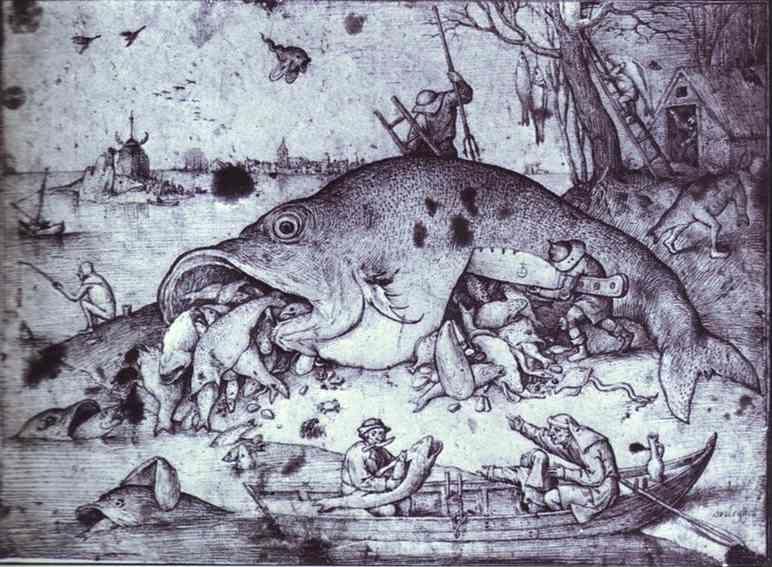
1556. Ink on paper. Graphische Sammlung Albertina, Vienna, Austria.
- The Hunters In The Snow (January).
1565. Oil on panel. Kunsthistorisches Museum, Vienna, Austria.
- The Gloomy Day (February).
1565. Oil on panel. Kunsthistorisches Museum, Vienna, Austria.
- Haymaking (July).
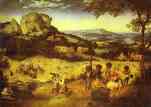
1565. Oil on panel. Narodni Gallery, Prague, Czech Republic.
- The Corn Harvest (August).
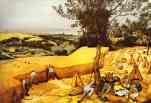
1565. Oil on panel. The Metropolitan Museum of Art, New York, USA.

