Dieric Bouts the Elder Biography
Alongside Hans Memling, Bouts can be considered the most important successor to Rogier van der Weyden.
Born and trained in Haarlem, Dieric Bouts the Elder (also: Dirk, Dierick) spent most of his life in Leuven working for Flemish aristocrats. Little is known about his training and work. Even if not actually a pupil of Rogier himself, Bouts was profoundly affected by his work. He continued and developed Rogier’s style to an almost radical degree: his preference of vertical compositions, of types instead of individual, exquisite, thoroughly detailed garments, which conceal the body, looks like a return to the Gothic. Whether Bouts was the founder of this ‘gothic revival’, a characteristic of Netherlandish Northern Renaissance, or whether the painter was simply part of the more general trend sweeping over Europe after the middle of the century, is hard to decide. Whatever the case, the stylistic features already described intensified after
The Last SupperAltar in Leuven (1464-1467) to the Justice panels in Brussels (begun 1468). The Last Supper from Sankt Peter in Leuven forms the central panel of a winged altarpiece commissioned by the confraternity of the Holy Sacrament. The painter was bound by contract to execute the work himself and thereby to follow the directions of two professors of theology.
In 1468, Bouts was commissioned to paint 4 panels for the courtroom of the city of Leuven. By the time he died, however, he had only finished one painting: The Empress's Ordeal by Fire in front of Emperor Otto III. (c.1470-1475). The episode related in the panel concerns calumny. The Empress is denouncing the innocent Count, whom she attempted to seduce, to Otto III. She is subjected to an ordeal by fire, which proves to the Count’s innocence. The story is derived from the Biblical tale of Potiphar’s wife, who tried to seduce Joseph in Egypt and who leveled false accusations at him when he refused her. Bouts may have taken his inspiration from Rogier van der Weyden, who painted similar subjects for the Town Hall in Brussels in 1436; however, these were destroyed in 1695.
In 1465, Bouts married Katharina van der Brugghen, the daughter of a respectable Leuven family. He remained based in Leuven enjoying an excellent reputation as a painter. He is last mentioned in records dated 17 April 1475.
It is frequently difficult to draw a clear line between his own work and that of his workshop, including his son Dieric Bouts the Younger. It is therefore impossible to make a fair assessment of his art.
Bibliography
Thierry Bouts. By V. Deni. Bruxelles. 1957.
Painting of Europe. XIII-XX centuries. Encyclopedic Dictionary. Moscow. Iskusstvo. 1999.
Dirk Bouts (ca. 1410-1475). Een Vlaams primitief te Leuven. by Dieric Bouts. Peeters, 1998.
Bouts Studies: Proceedings of the International Colloquium, Leuven, 26-28 November 1998 by Bert Cardon. Peeters Bvba, 2001.
- Last Supper (Central Section Of An Alterpiece).
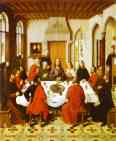
1464-1467. Tempera on wood. Sankt Peter, Louvain, Belgium. Read Note.
- The Empress's Ordeal By Fire In Front Of Emperor Otto Iii.
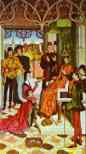
c.1470-1475. Tempera on wood. Musées Royaux des Beaux-Arts, Brussels, Belgium. Read Note.

