Sir Lawrence Alma-Tadema Biography
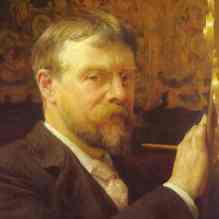
Sir Lawrence Alma-Tadema, the painter of "Victorians in togas", was one of the most successful artists of the XIX century. He was internationally famous and so immensely popular that scarcely a middle-class Victorian drawing room was without at least one print of Alma-Tadema's painting. Yet a few years after his death he was all but forgotten.
Laurens (later he changed to the more English Lawrence) Tadema was born on 8 January 1836, in the small village of Dronrijp, which lies about 3 miles to the west of Leeuwarden, Holland. He was the sixth child of Pieter Jiltes Tadema, a notary. It is unclear when and why he affixed the name Alma to his last name, probably it was the name of his godfather. His parents wanted him to become a lawyer and Laurens was enrolled at the gymnasium of Leeuwarden. Although Laurens was a good student, he always wanted to be an artist and, with great enthusiasm he tried to pursue both courses. This caused a significant decline of his health that his doctors even predicted he would die shortly. His mother decided to allow him to spend his remaining days doing what he enjoyed most, to paint. But happily after that he recovered completely. This marked the beginning of a new period of his life. In 1851, he went to Antwerp to study in the Antwerp Academy, where he was taught first by Gustave Wappers and then by Nicaise de Keyser. He left the Academy in 1856 and continued to study art and also took up the history of Germany, early France and Belgium under the guidance of Louis de Taye, the Professor of Archaeology at the Academy of Antwerp. Faust and Marguerite (1857) was painted as a result of these studies. In 1859 Alma-Tadema became a pupil of Henrik Leys, joining his studio in Antwerp. In 1861, Tadema's picture The Education of the Children of Clovis (1868) was exhibited and became a success.
In 1862, Alma-Tadema left Leys's studio and started his own career. The period 1862-1870 is called his Continental period, he established himself as a significant contemporary European artist. His main works were of classical genre, dedicated to Ancient Egypt: An Egyptian Widow (1872) and Greek and Roman history: A Roman Family (1868), An Audience at Agrippa's (1876). In 1870, Alma-Tadema moved to England, where he was to spend the rest of his life. He became one of the most famous and highly paid artists of his time, acknowledged and rewarded by the fellow artists as well as by the governments of the European countries. In 1879, he was elected as a full member of the Royal Academy of Arts and in 1899 was knighted by Queen Victoria. Among his most famous works are An Apodyterium (1886), Spring (1894), The Coliseum (1896), The Baths of Caracalla (1899), Silver Favourites (1903), The Finding of Moses (1904), A Favourite Custom (1909). AlmaTadema died in 1912.
Bibliography
Sir Lawrence Alma-Tadema. by V.G. Swanson. London. 1977.
Victorian Painting. by Christopher Wood. Bulfinch Press 1999.
Painting of Europe. XIII-XX centuries. Encyclopedic Dictionary. Iskusstvo. 1999. (in Russian)
Lawrence Alma-Tadema by R. J. Barrow, Barrow R. J., Lawrence Alma-Tadema, Rosemary Barrows. Phaidon Press Inc., 2001.
Sir Lawrence Alma-Tadema by Russell Ash. Harry N Abrams, 1990.
- Faust And Marguerite.
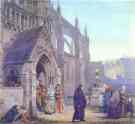
1857. Watercolour on paper. John Constable Esq., UK. Read Note.
- The Education Of The Children Of Clovis.
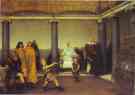
1868. Oil on panel. M. Knoedler & Co., New York, USA. Read Note.
- An Egyptian Widow.
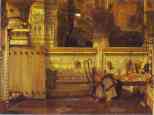
1872. Oil on panel. Rijksmuseum, Amsterdam, the Netherlands.

